
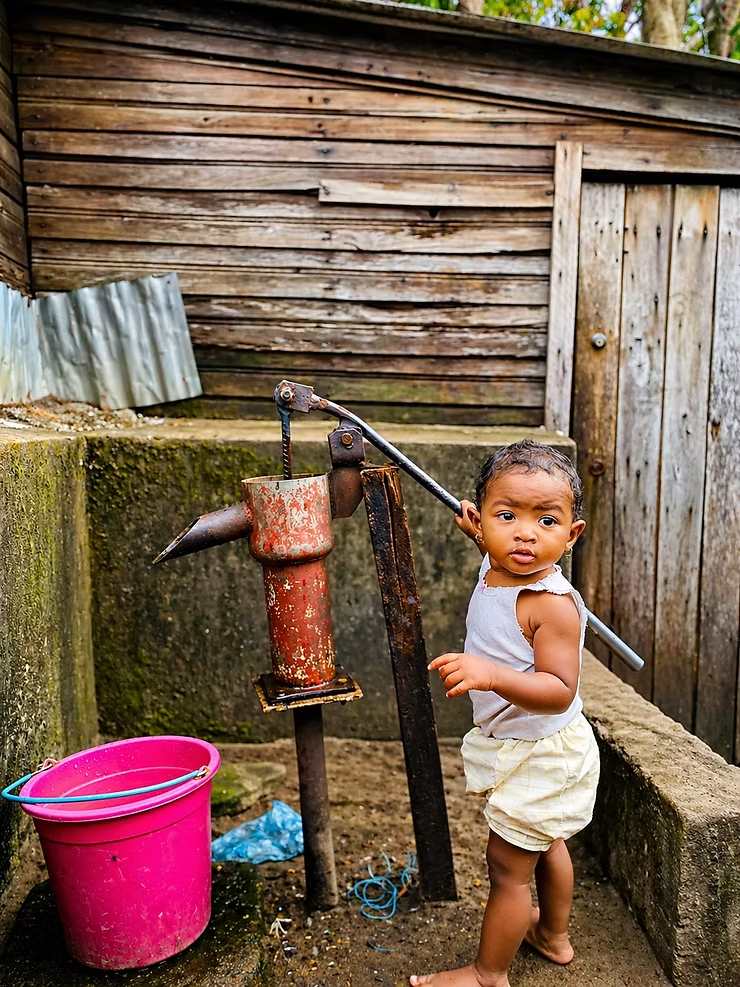
For thousands of families across Toamasina, the pompe tany — the humble pitcher pump — is the difference between clean water and no water at all. Tucked into courtyards and along neighbourhood pathways, these hand pumps supply drinking, cooking, and washing water to roughly three-quarters of the coastal population, at a time when piped municipal water remains too expensive or too unreliable for most households. They are a genuine success story of self-supply engineering: cheap to build, easy to maintain, and locally manufactured by technicians who have kept the design largely unchanged since the 1960s.
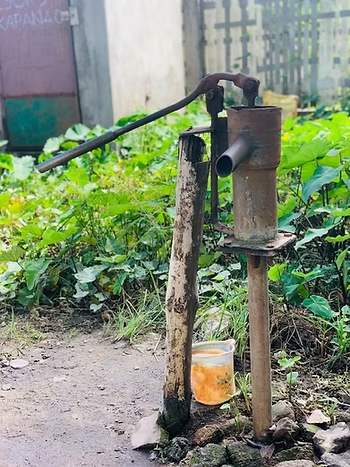
Families in Toamasina rely on pitcher pumps for their daily water needs
But that same design has a hidden flaw, and it has been quietly poisoning the children who drink from it. Research carried out directly in Toamasina over the last decade has shown that many pitcher pumps leach dangerous levels of lead into the water they produce — and that this lead is ending up in the bloodstreams of the city's youngest residents. The good news, confirmed by the same research, is that this is one of the most fixable public health problems Toamasina faces. It does not require new wells, new pipes, or years of infrastructure investment. It requires changing a handful of small metal parts.
Why Lead in Water Is So Dangerous
Lead is a heavy metal with no safe level of exposure, and no biological role in the human body. Once it enters the bloodstream, it circulates and accumulates in soft tissue, bone, and — most damagingly — the developing brain. Children absorb lead far more efficiently than adults and are far more vulnerable to its effects, because their nervous systems are still forming. Even low-level, chronic exposure is linked to reduced IQ, shortened attention span, behavioural problems, delayed development, anaemia, and, at higher levels, seizures and death. Because the early symptoms are often invisible — a child does not "look" lead-poisoned — the damage is frequently done long before anyone suspects a problem, and much of it cannot be reversed.
For pregnant women, lead crosses the placenta and can affect fetal brain development. For everyone, sustained exposure raises the risk of high blood pressure, kidney damage, and cardiovascular disease later in life. The World Health Organisation has set a provisional guideline of 10 micrograms of lead per liter of drinking water — not because that level is "safe," but because it represents a practical limit given current treatment capabilities.
What Researchers Found in Toamasina's Pumps
Between 2013 and 2014, engineers from the University of South Florida, working with local partners, tested water from pitcher pumps at 18 households in Tamatave (Toamasina) over three separate sampling campaigns. What they found was alarming. Under "first-draw" conditions — meaning water pumped after the system had been sitting unused for about an hour, which is how most families actually collect their water first thing in the morning — 67% of samples exceeded the WHO's 10 µg/L guideline, with a typical concentration of 13 µg/L. Fifteen of the eighteen pumps tested produced at least one sample above the guideline at some point during the study.
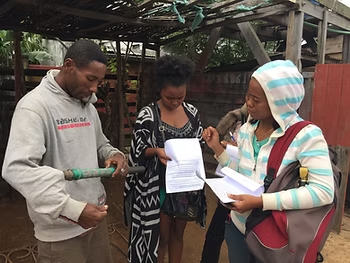
Researchers testing water quality from pitcher pumps in Toamasina
Flushing the pump — running water through it for a period before collecting drinking water — helped. Flushed samples showed significantly lower lead levels, with about 35% still exceeding the guideline and a typical concentration of 9 µg/L. But flushing is not a fix; it is a partial mitigation that depends on households having the time, water access, and awareness to do it consistently, every single day, for every draw of water.
The researchers found that the contamination was not linked to how old a pump was, which company manufactured it, how deep the well was, or the season. The one factor that mattered was how long the water had been sitting in contact with the pump's internal parts. That is a strong clue about where the lead was actually coming from — not the groundwater itself, but the pump hardware.
A companion graduate research study dug further into this question. It confirmed that access to safe water in Madagascar sits below 50%, and that piped, treated water remains financially out of reach for many urban and peri-urban households — which is exactly why the pitcher pump has endured as a practical, trusted solution since the 1960s. The study went on to isolate the source of the lead: check valves inside the pump, cast from recycled lead that is melted down and poured by hand into sand molds by local technicians.
In pilot tests where these leaded valves were swapped for iron ones at two households, lead concentrations dropped dramatically — from a range of 37 to 100 µg/L down to just 3–4 µg/L at one home, and from 7–24 µg/L down to 2–8 µg/L at the other.
Using U.S. EPA modeling, researchers estimated that these lead levels could plausibly push children's blood lead levels into the range associated with serious, lasting health effects.
Proof That the Fix Works: The 2023 Intervention
The most powerful evidence, however, comes from a follow-up study published in 2023, which moved beyond pilot testing to a real, city-scale intervention in Toamasina. Researchers and local partners worked directly with pump technicians to remove the leaded piston and foot valves from hand pumps across the city and replace them with non-leaded, iron components.
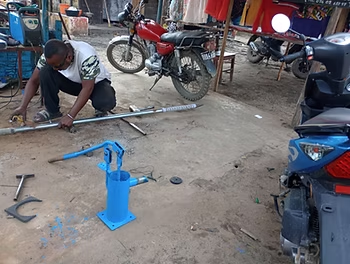
Local technicians in Toamasina replacing leaded pump parts with safe alternatives
The results were striking. After remediation, aqueous lead levels fell below the WHO's provisional guideline in all but 4% of the pumps tested. Just as important, the study measured actual blood lead levels in children before and after the intervention, not just water chemistry, but real health outcomes in real children. 87% of the children tested went down following the pump remediation.
Why This Matters for Toamasina Today
Following these studies and various intervention efforts, the problem is not fully solved — but it is fully solvable, and we now have direct, local, peer-reviewed evidence of exactly how to solve it. There is a solution designed, tested, and proven in Toamasina, working with Toamasina's own pump technicians, using materials Toamasina's own workshops can access.
Lead Poisoning in Toamasina Can Be Eliminated
When cast-lead check valves are replaced with iron or other non-leaded alternatives, aqueous lead contamination falls dramatically — and, most importantly, children's blood lead levels fall with it.
This points to a clear path forward for the city and its communities:
- Every remaining pump with leaded valves should be prioritized for retrofit with iron components, following the same process already validated by our technician training pilot programme.
- Local technicians are key. They understand the needs of the community; by educating them and training them, we create durable change by eliminating opportunistic use of lead parts in pump repair and construction.
- Public awareness matters. The people of Toamasina can advocate for better materials in their pumps and wells if they know what materials to look out for.
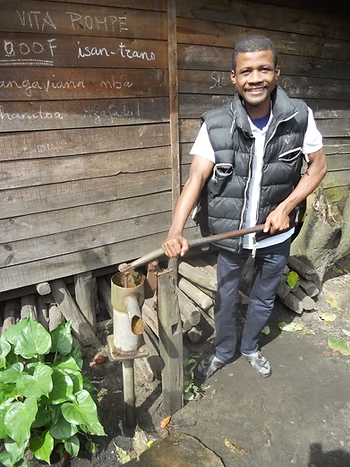
Community awareness and education are key to eliminating lead exposure
Toamasina does not need to choose between accessible water and safe water. The evidence shows we can have both — and the tools to get there are already in local technicians' hands.